Usual hours and prices, checked 2026-09-13 against the sources under “What this place is”. They can change for holidays and events — confirm before you go. Official site
AD 🛏️ Hotels nearby on Agoda ↗ About this link
Our guide
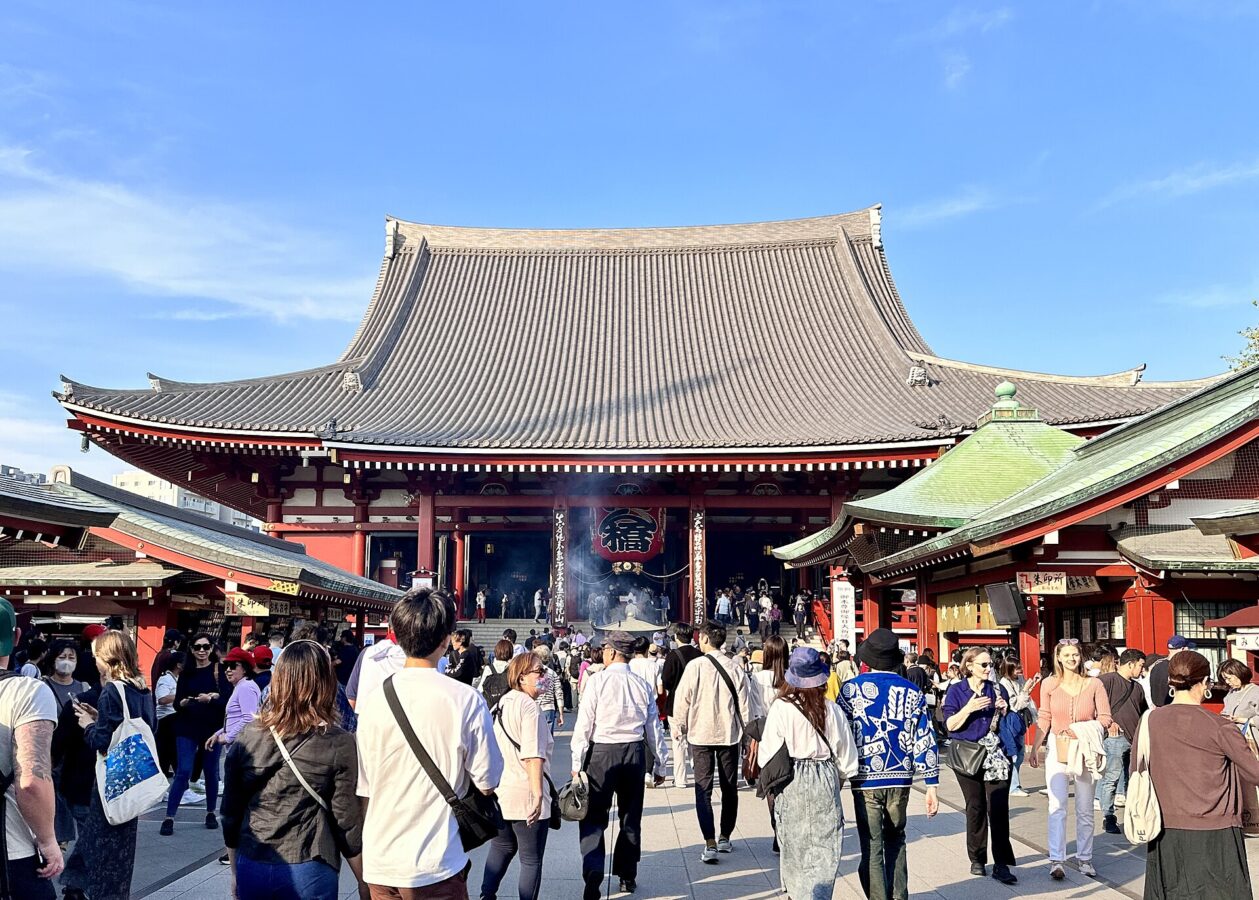
Sensō-ji, also known as Asakusa Kannon, is Tokyo's oldest temple and one of its most important. It is dedicated to Kannon, the bodhisattva of compassion, and it is extraordinarily popular: with more than 30 million visitors a year it has been called the most visited religious site in the world. Its buildings include large gates, the main hall and a five-storey pagoda, and the street leading to it, Nakamise-dōri, is lined with shops selling traditional goods.
The temple was destroyed in the air raid of 10 March 1945, and the main hall was rebuilt in the 1950s. It is also stop 13 on the Bandō pilgrimage. The main hall opens early: 6:00, or 6:30 from October to March. Asakusa Station is about 5 minutes on foot.
Tokyo Skytree is about 1.4 km away in a straight line, and the Ueno museums around Ueno Park about 2 km.
Written by japan-spots.com (2026-09-22) from the sources credited on this page. Distances are straight lines between map positions.
Photos
Photos from Wikimedia Commons, each under its own licence — see credits
- Sensoji 2023 — Akonnchiroll · CC0 · source · resized
- AsakusaShrine1443 — Fg2 (uploader on Commons) · Public domain · source · resized
- Asakusa - Senso-ji 35 (15576702197) — Joe Mabel on Flickr as Joe Mabel from Seattle, US · CC BY-SA 3.0 · source · resized
- Asakusa Nakamise — 田山宗尭 · Public domain · source · resized
- Asakusa Senso-ji 2021-12 ac (2) — Asturio Cantabrio · CC BY-SA 4.0 · source · resized
- Asakusa Temple at Tokio (3109868519) — New York Public Library · No restrictions · source · resized
- Asakusa during snowfall - Flickr - Manish Prabhune — Manish Prabhune from 東京, 日本 · CC BY 2.0 · source · resized
- Asakusa sensoji06s3200 — 663highland · CC BY 2.5 · source · resized
- Dai Nippon Kinryū-zan no Zu, Aōdō Denzen, 1809 — Aōdō Denzen (亜欧堂田善) · Public domain · source · resized
What this place is
Sensō-ji (浅草寺, Sensō-ji; officially Kinryū-zan Sensō-ji (金龍山浅草寺), also known as Asakusa Kannon (浅草観音)), is an ancient Buddhist temple in Asakusa, Tokyo, Japan. It is Tokyo's oldest-established temple, and one of its most significant. It is dedicated to Kannon, the bodhisattva of compassion. Structures in the temple complex include the main hall, a five-story pagoda and large gates. It is the most widely visited religious site in the world with over 30 million visitors annually. The temple is the 13th stop on the Bandō Sanjūsankasho pilgrimage route. The temple was destroyed during a 10 March 1945 firebombing air raid on Tokyo during World War II.The main hall was rebuilt in the 1950s. Formerly associated with the Tendai sect of Buddhism, the temple became independent in 1950 after the war. Leading to it is Nakamise-dōri street, containing many shops with traditional goods.
Visitor information checked: 2026-09-13 · Sensō-ji: access
Background text from Wikipedia (CC BY-SA 4.0)
What to expect at this type of place: Temple
Getting there by public transport
- Asakusa Station, about 5 minutes on foot — on the Tōbu Skytree Line, the Tokyo Metro Ginza Line, the Tsukuba Express, or the Toei Asakusa Line (Exit A4).
Route checked: 2026-09-13 · Sensō-ji: access · Timetables change — check the operator before you travel.
Where to stay nearby
Hotels near Senso-ji Temple on Agoda
AD Affiliate link: if you book through it, we may earn a commission from Agoda, at no extra cost to you. Hotels, prices and availability are Agoda’s, for the whole town around this spot.
Traveler reviews
No reviews yet — be the first to share how it went.