Usual hours and prices, checked 2026-10-05 against the sources under “What this place is”. They can change for holidays and events — confirm before you go. Official site
Our guide
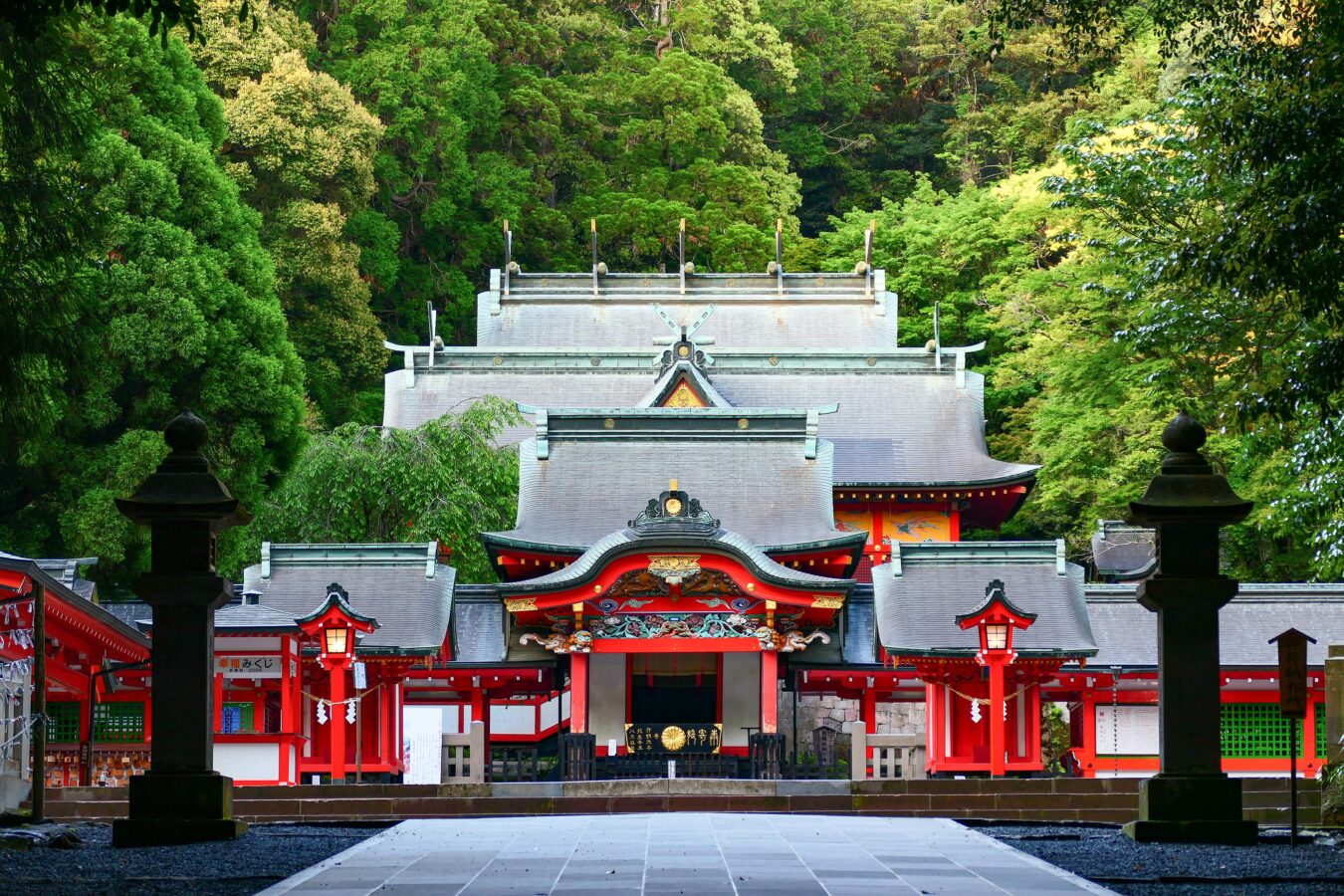
Kirishima Jingū, in Kirishima, is bound up with the myth of the descent of the gods from heaven: Takachiho-gawara, the place where that descent is said to have happened, is within the shrine's grounds, and historically the whole of Mount Kirishima counted as shrine land. It is dedicated to Ninigi-no-Mikoto and several other gods of the same myth cycle. Volcanic eruptions have destroyed the shrine several times, and several of its present buildings, among them the main sanctuary and the worship hall, are Important Cultural Properties.
We have not checked a public-transport route or opening arrangements, so plan the journey on the map and look for local information before you go. Several of the same gods are venerated at Udo Shrine, on the Miyazaki coast.
Written by japan-spots.com (2026-09-22) from the sources credited on this page. Distances are straight lines between map positions.
Photos
Photos from Wikimedia Commons, each under its own licence — see credits
- Kirishima-Jingu Front — MaedaAkihiko · CC BY-SA 4.0 · source · resized
- 霧島神宮(鳥居) — 矢野弘幸 · CC BY-SA 4.0 · source · resized
- Takachiho-gawara Kirishima City Kagoshima Pref02n4050 — 663highland · CC BY 2.5 · source · resized
- KirishimaJingu 04 — hirase · CC BY-SA 3.0 · source · resized
- KirishimaJingu 02 — Hirase · CC BY-SA 3.0 · source · resized
- KirishimaJingu6816 — 日: Jnn · CC BY 2.1 jp · source · resized
- Kirishima-jingu06n4592 — 663highland · CC BY 2.5 · source · resized
- Kirishima-jingu05n4440 — 663highland · CC BY 2.5 · source · resized
- Kirishima-jingu03n4592 — 663highland · CC BY 2.5 · source · resized
- Kirishima-jingu15n4350 — 663highland · CC BY 2.5 · source · resized
What this place is
Kirishima-Jingū (霧島神宮) is a Shinto shrine located in Kirishima, Kagoshima Prefecture, Japan. Takachiho-gawara the location of the descent from heaven is present on the shrine grounds. Historically, the entire of Mount Kirishima is considered part of the shrine grounds. Today, parts of the mountains where festivals take place and the location of the Tenson kōrin is considered part of the shrine grounds. It is dedicated to Konohanasakuya-hime, Hoori, Toyotama-hime, Ugayafukiaezu, Tamayori-bime, and Ninigi-no-Mikoto. This shrine holds several Important Cultural Properties, such as the honden, heiden, haiden, tōrōka (登廊下), Chōkushiden (勅使殿), etc. It has been destroyed several times by volcanic eruptions.
Visitor information checked: 2026-10-05 · 交通アクセス – 霧島神宮
Background text from Wikipedia (CC BY-SA 4.0)
What to expect at this type of place: Shrine
Getting there
We do not have step-by-step transit directions for this spot yet. Open the location on Google Maps for routes from where you are staying.
Traveler reviews
No reviews yet — be the first to share how it went.