Usual hours and prices, checked 2026-09-15 against the sources under “What this place is”. They can change for holidays and events — confirm before you go. Official site
AD 🛏️ Hotels nearby on Agoda ↗ About this link
Our guide
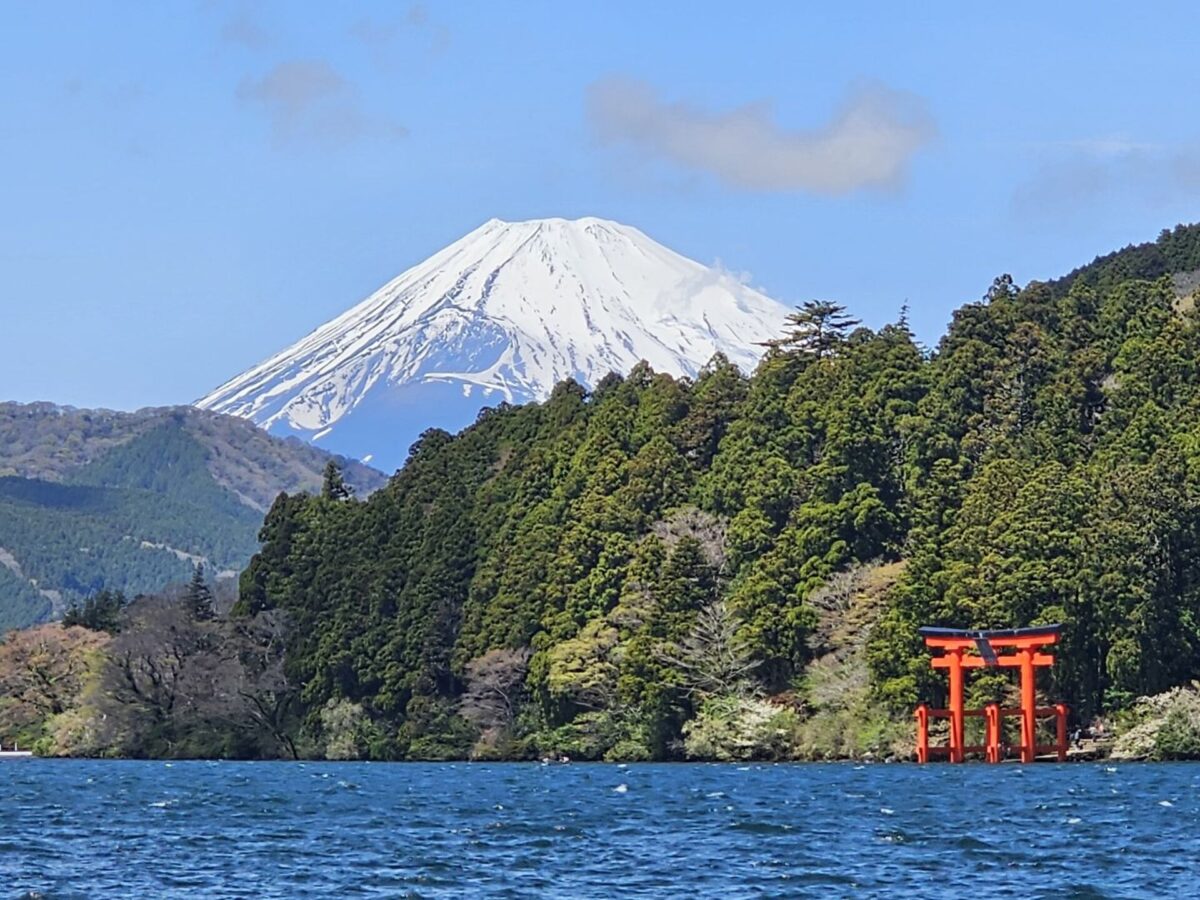
There are two ways to have Mount Fuji, and most visitors only need the first: seeing it. At 3,776 m it is the highest mountain in Japan, and on a clear day it shows from Tokyo, about 100 km away. The near-perfect cone carries snow for about five months of the year, which is when it looks most like the postcards.
Climbing it is a different trip altogether, possible only in the summer season, and on one of four trails — Yoshida, Fujinomiya, Subashiri or Gotemba — chosen mostly by where you start from. Every climber now registers online and pays a hiking fee before setting off, and nobody may start up in the afternoon or at night unless they are staying at a mountain hut. The dates, fee and bus routes we have checked are under “Plan your visit” below.
Written by japan-spots.com (2026-09-22) from the sources credited on this page. Distances are straight lines between map positions.
Photos
Photos from Wikimedia Commons, each under its own licence — see credits
- 273 Mt. Fuji und Heiwa no Torii vom Motohakone Port — Ekki3 · CC BY-SA 4.0 · source · resized
- Fuji im Mai 2026 — Fckmarcsaar · CC BY-SA 4.0 · source · resized
- Fuji Under Polaris — Victor Porof · CC BY-SA 3.0 · source · resized
- Fuji, assorted - FujiAssorted6854 — lumoplank · CC0 · source · resized
- Fuji, assorted - FujiAssorted6859 — lumoplank · CC0 · source · resized
- Fuji-san (8209667062) — Thomas Woodtli from Zürich, Switzerland · CC BY 2.0 · source · resized
- Fujiyama (49028832257) — Doktor Propeller · CC BY 2.0 · source · resized
- Kawaguchiko, Part I - Kawaguchiko6814 — lumoplank · CC0 · source · resized
What this place is
Mount Fuji (富士山・富士の山, Fujisan, Fuji no Yama) is an active stratovolcano located on the Japanese island of Honshu, with a summit elevation of 3,776.24 m (12,389 ft 3 in). It is the highest mountain in Japan, the second-highest volcano on any Asian island (after Mount Kerinci on the Indonesian island of Sumatra), and the seventh-highest peak of an island on Earth. Mount Fuji last erupted from 1707 to 1708. It is located about 100 km (62 mi) southwest of Tokyo, from which it is visible on clear days. It has an exceptionally symmetrical cone, which is covered in snow for about five months of the year. It is a Japanese cultural icon and is frequently depicted in art and photography, as well as visited by sightseers, hikers, and mountain climbers.
Visitor information checked: 2026-09-15 · Mt. Fuji Climbing (official): things to know before climbing · Mt. Fuji Climbing (official): 2026 operating periods · Mt. Fuji Climbing (official): trails and access to the trailheads
Background text from Wikipedia (CC BY-SA 4.0)
What to expect at this type of place: Mountain
Getting there by public transport
- Yoshida Trail (Yamanashi): Fuji Kyuko climbing buses run to the Fuji-Subaru Line 5th Station from Fujikawaguchiko Station and Fujisan Station, and direct express buses run from Busta Shinjuku.
- Fujinomiya Trail (Shizuoka): climbing buses run to the Fujinomiya Trail 5th Station from Mishima, Shin-Fuji, Fuji and Fujinomiya stations.
- Subashiri Trail: climbing buses run from Gotemba and Shin-Matsuda stations.
- Gotemba Trail: climbing buses run from Gotemba Station to the New 5th Station.
- During the summer private-car restrictions you cannot drive up to the Yoshida, Fujinomiya or Subashiri 5th stations.
- For Yoshida take the shuttle bus from Fujisan Parking; for Fujinomiya, the shuttle bus or a taxi from Mizugatsuka Parking.
Route checked: 2026-09-15 · Mt. Fuji Climbing (official): things to know before climbing · Mt. Fuji Climbing (official): 2026 operating periods · Mt. Fuji Climbing (official): trails and access to the trailheads · Timetables change — check the operator before you travel.
Where to stay nearby
Hotels near Mount Fuji on Agoda
AD Affiliate link: if you book through it, we may earn a commission from Agoda, at no extra cost to you. Hotels, prices and availability are Agoda’s, for the whole town around this spot.
Traveler reviews
No reviews yet — be the first to share how it went.