Opening hours and admission for this place have not been checked yet, so none are shown. Check the official site
Our guide
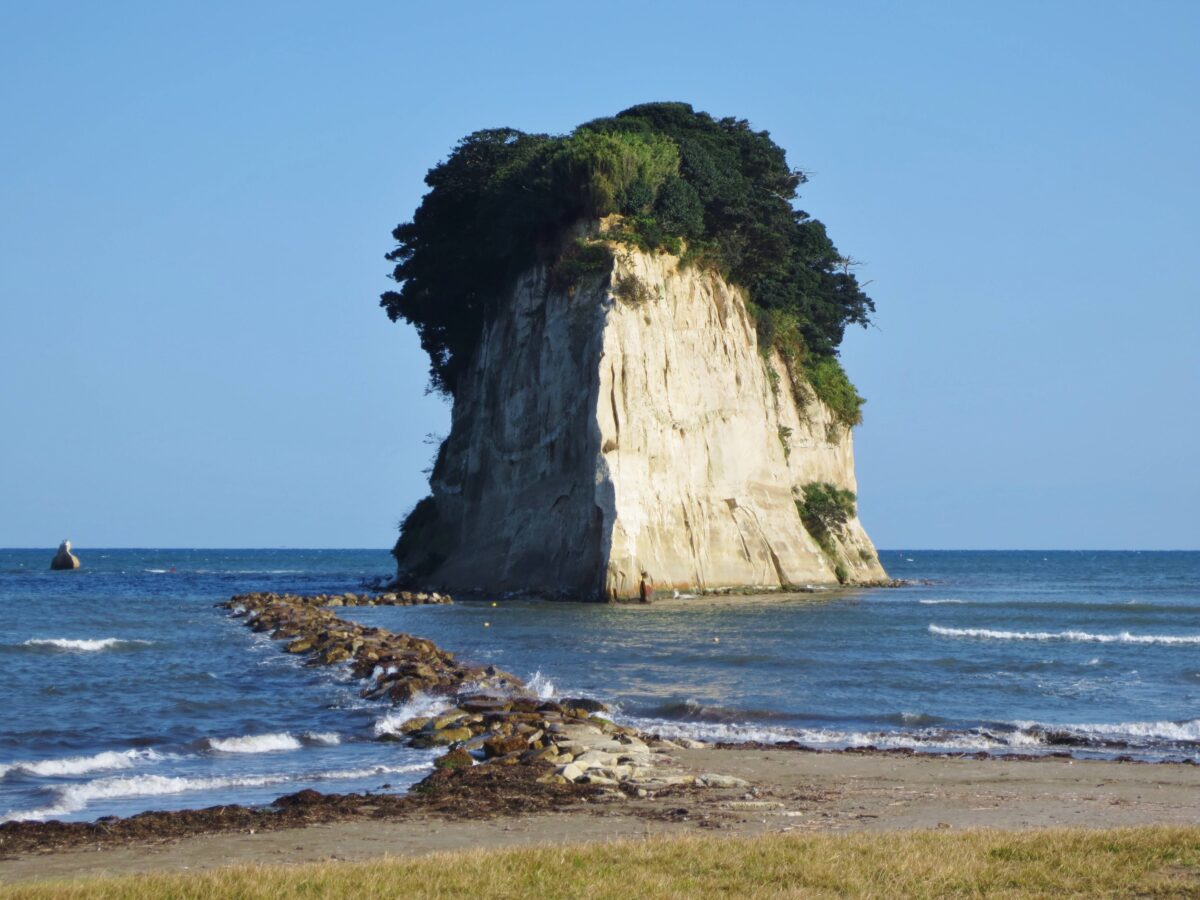
Mitsukejima is an uninhabited island in the Takadate area of Suzu, Ishikawa. Because of its shape it is also called Gunkanjima, “Battleship Island”, the same nickname as Hashima in Nagasaki. Legend says the monk Kūkai found and named it while travelling from Sado Island. It is about 150 m long, 50 m wide and 30 m high, made of Neogene diatomaceous earth, the raw material of Suzu's shichirin clay cooking stoves, and its top is covered with Japanese black pine and knotweed. It is a well-known scenic spot of Noto Hantō Quasi-National Park.
We have not checked a public-transport route, so look for local information before you go.
Written by japan-spots.com (2026-09-22) from the sources credited on this page. Distances are straight lines between map positions.
Photos
Photos from Wikimedia Commons, each under its own licence — see credits
- Mitsukejima (Ishikawa) 1 — photo: Qurren ( talk ) Taken with Canon IXY 430F (Digital IXUS 245 HS) · CC BY-SA 3.0 · source · resized
- R6 noto earthquake suzu mitsuke-jima 2024-02-16 1 — Hurohukidaikon · CC BY 4.0 · source · resized
- Mitsukejima resthouse — photo: Qurren ( talk ) Taken with Canon IXY 430F (Digital IXUS 245 HS) · CC BY-SA 3.0 · source · resized
- Mitsukejima (Ishikawa) 3 — photo: Qurren ( talk ) Taken with Canon IXY 430F (Digital IXUS 245 HS) · CC BY-SA 3.0 · source · resized
- Mitsukejima (Ishikawa) 2 — photo: Qurren ( talk ) Taken with Canon IXY 430F (Digital IXUS 245 HS) · CC BY-SA 3.0 · source · resized
- Mitsuke no yashiro — photo: Qurren ( talk ) Taken with Canon IXY 430F (Digital IXUS 245 HS) · CC BY-SA 3.0 · source · resized
- Mitsukejima (Ishikawa) 4 — photo: Qurren ( talk ) Taken with Canon IXY 430F (Digital IXUS 245 HS) · CC BY-SA 3.0 · source · resized
What this place is
Mitsukejima (見附島) is an uninhabited island in Takadate-cho, Suzu, Ishikawa, Japan. Due to its shape, it is also known as Gunkanjima (軍艦島; Battleship Island), which is also the common name given to Hashima Island in Nagasaki Prefecture. According to folklore, the island was given the name "Mitsukejima" by the Buddhist monk, scholar, and artist Kūkai, who was the first to discover the island while travelling from Sado Island. Mitsukejima is approximately 150 metres long, 50 metres wide, and 30 metres above sea level. It is composed of Neogene-period diatomaceous earth, the raw materials commonly used for shichirin, a portable clay cooking stove which is a specialty product of Suzu. The top of the island is covered with Japanese black pine and Japanese knotweed. Mitsukejima is known as a scenic spot of the Noto Hantō Quasi-National Park, and attracts many tourists.
Background text adapted from Wikipedia (CC BY-SA 4.0)
What to expect at this type of place: Island
Getting there
We do not have step-by-step transit directions for this spot yet. Open the location on Google Maps for routes from where you are staying.
Traveler reviews
No reviews yet — be the first to share how it went.