Usual hours and prices, checked 2026-10-05 against the sources under “What this place is”. They can change for holidays and events — confirm before you go. Official site
Our guide
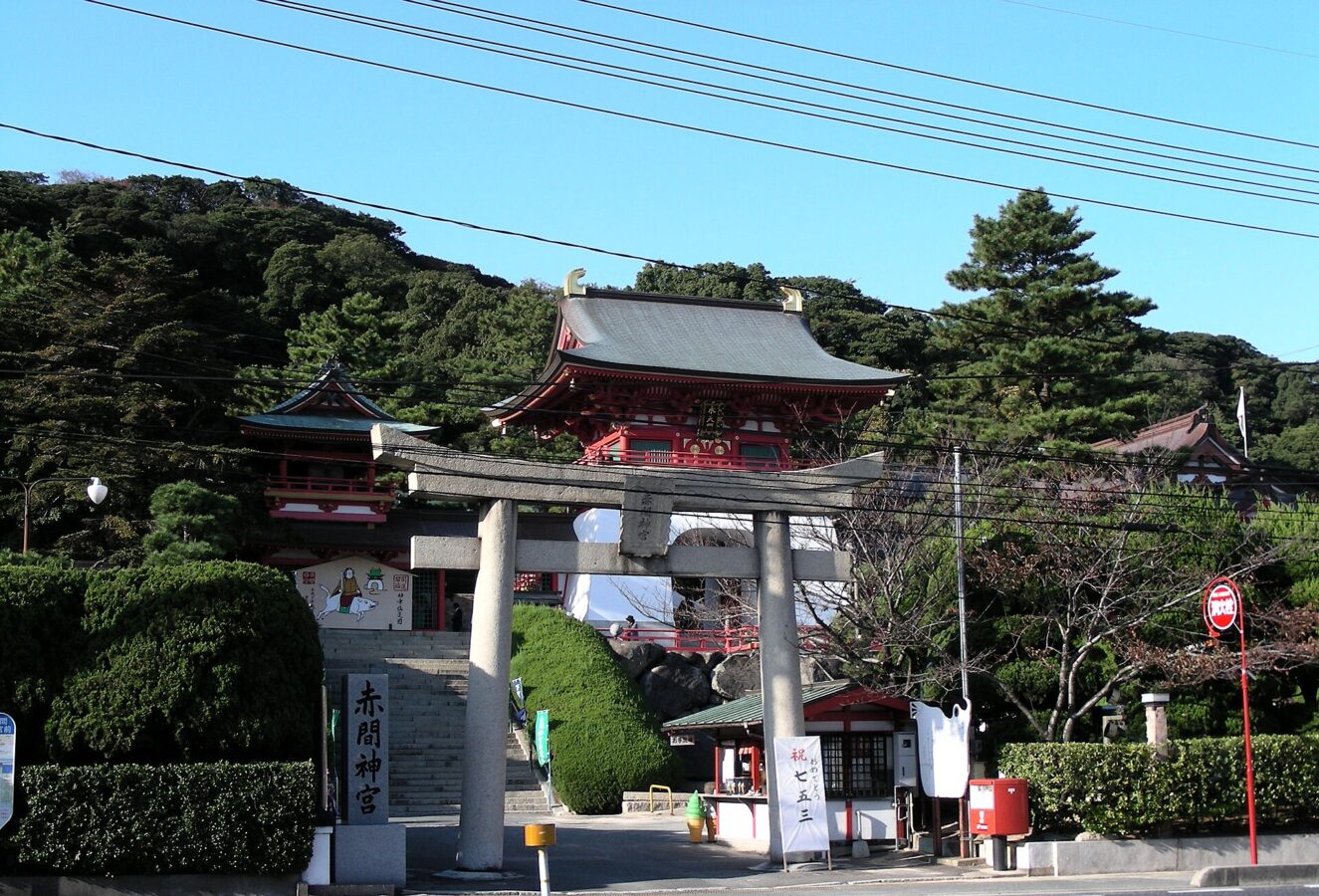
Akama Jingu in Shimonoseki is dedicated to the child Emperor Antoku, who died in the Battle of Dan-no-ura, fought nearby in 1185. That battle ended the Genpei War: the Minamoto defeated the Taira and ended the Taira bid for control of Japan. The present shrine stands on the grounds of the former Buddhist temple Amidaji and its cemetery. Its bright red main gate makes it easy to spot.
The shrine is on the waterfront of the Kanmon Straits, between central Shimonoseki and Karato. Karato Market and Kameyama Hachimangū are each about 400 m away in a straight line. We have not checked a public-transport route.
Written by japan-spots.com (2026-09-22) from the sources credited on this page. Distances are straight lines between map positions.
Photos
Photos from Wikimedia Commons, each under its own licence — see credits
- Akama jingu — Usiwakamaru · Public domain · source · resized
- Akama jingu maingate — 설총 · CC BY-SA 3.0 · source · resized
- AntokuTennou Engi.1 Seitan — 伝土佐光信 · Public domain · source · resized
- AntokuTennou Engi.2 Gokou — 伝土佐光信 · Public domain · source · resized
- AntokuTennou Engi.4 Ikuta — 伝土佐光信 · Public domain · source · resized
- AntokuTennou Engi.5 Ichinotani — 伝土佐光信 · Public domain · source · resized
- AntokuTennou Engi.6 Nasu Yoichi — 伝土佐光信 · Public domain · source · resized
- AntokuTennou Engi.7&8 Dannoura Kassen — Tosa Mitsunobu · Public domain · source · resized
What this place is
Akama Shrine (赤間神宮, Akama Jingū) is a Shinto shrine in Shimonoseki, Yamaguchi Prefecture, Japan. It is dedicated to the child Emperor Antoku, who died in the Battle of Dan-no-ura (aka Dannoura), which occurred nearby in 1185. This battle was important in the history of Japan because it brought an end to Genpei War in which the Minamoto clan defeated the rival Taira clan, and ended the Taira bid for control of Japan. The modern shrine is built on the grounds of the former Buddhist Amidaji Temple and its adjoining cemetery. The shrine is situated on the waterfront of the Kanmon Strait, between the centre of Shimonoseki and the tourist restaurants of Karato, Kanmon Wharf. The bright red main gate makes it a very visible sight.
Visitor information checked: 2026-10-05 · 赤間神宮|観光スポット|【公式】山口県観光/旅行サイト おいでませ山口へ
Background text from Wikipedia (CC BY-SA 4.0)
What to expect at this type of place: Shrine
Getting there
We do not have step-by-step transit directions for this spot yet. Open the location on Google Maps for routes from where you are staying.
Traveler reviews
No reviews yet — be the first to share how it went.