Usual hours and prices, checked 2026-09-15 against the sources under “What this place is”. They can change for holidays and events — confirm before you go. Official site
AD 🛏️ Hotels nearby on Agoda ↗ About this link
Our guide
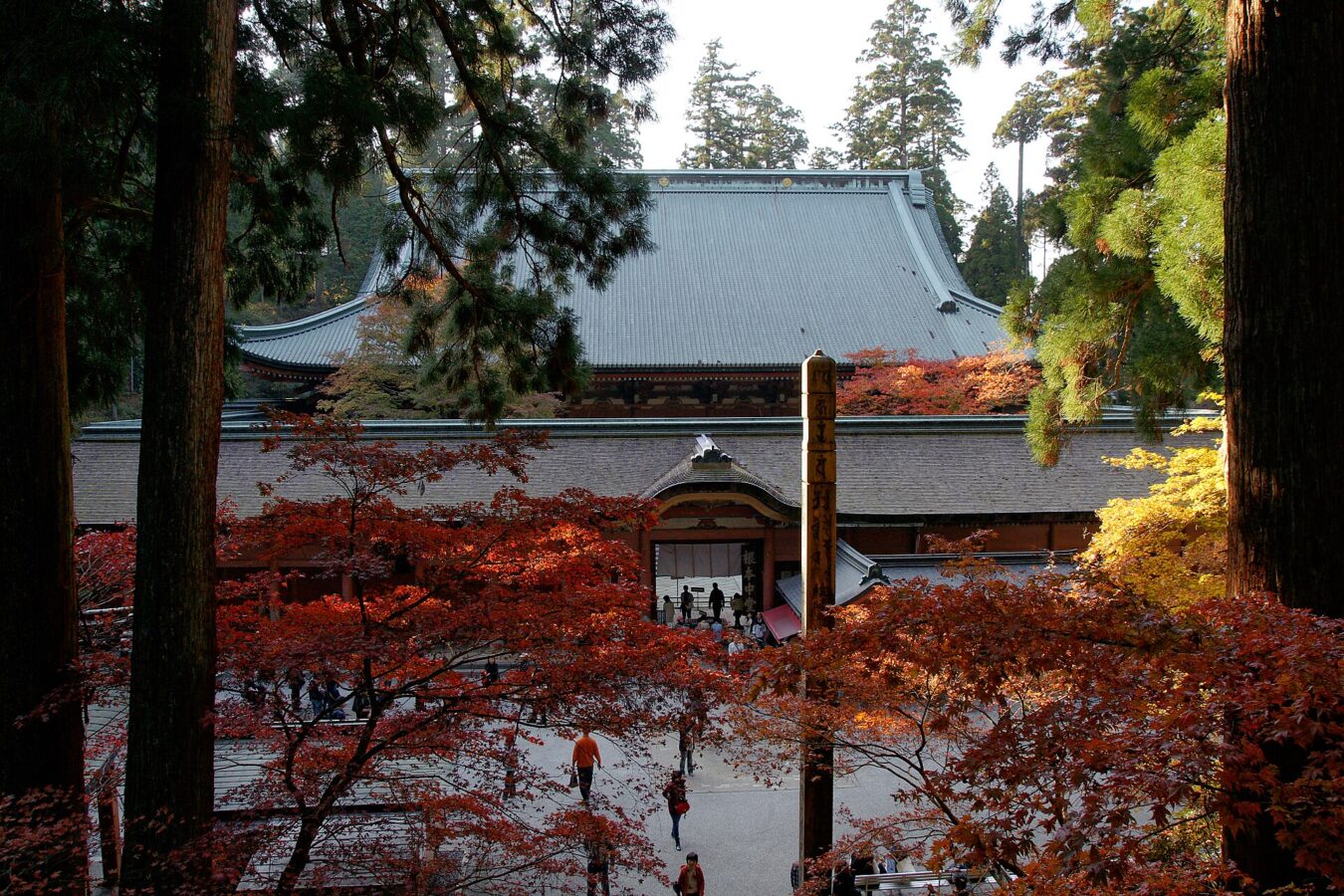
Enryaku-ji, on Mount Hiei above Kyoto, is one of the most important monasteries in Japanese history. It was founded in 788 by Saichō, who brought the Tendai school of Buddhism from China, and it is still the Tendai headquarters. Its influence reached far beyond its own school: the founders of Jōdo-shū, Jōdo Shinshū, Sōtō Zen and Nichiren Buddhism all spent time here. It is also the centre of kaihōgyō, the practice of the “marathon monks”, and part of the UNESCO World Heritage Site of Ancient Kyoto.
The temple is spread across three areas — Tōdō, Saitō and Yokawa — and one ticket covers all three. Tickets are sold until 15:45, and halls may close early in storms or snow, so it is a daytime visit. Cable Enryakuji Station on the Sakamoto Cable is about 500 m away in a straight line. Mount Hiei has its own page.
Written by japan-spots.com (2026-09-22) from the sources credited on this page. Distances are straight lines between map positions.
Photos
Photos from Wikimedia Commons, each under its own licence — see credits
- Enryakuji Konponchudo04n4272 — 663highland · CC BY 2.5 · source · resized
- Enryakuji Ninaido01n3200 — 663highland · CC BY 2.5 · source · resized
- Enryakuji Monjuro02n3200 — 663highland · CC BY 2.5 · source · resized
- Enryakuji Konponchudo02s5s3200 — 663highland · CC BY 2.5 · source · resized
- Enryakuji Kanchodo01n3200 — 663highland · CC BY 2.5 · source · resized
- Enryakuji Jogyodo01n3200 — 663highland · CC BY 2.5 · source · resized
- Enryakuji Hokkedo02n3200 — 663highland · CC BY 2.5 · source · resized
- Enryakuji Eryodo01n4272 — 663highland · CC BY 2.5 · source · resized
- Enryakuji Daikodo2 — KENPEI · CC BY-SA 3.0 · source · resized
- Enryakuji Amidado — KENPEI · CC BY-SA 3.0 · source · resized
What this place is
Enryaku-ji (延暦寺, Enryaku-ji) is a Tendai monastery located on Mount Hiei in Ōtsu, overlooking Kyoto. It was first founded in 788 during the early Heian period (794–1185) by Saichō (767–822), also known as Dengyō Daishi, who introduced the Tendai sect of Mahayana Buddhism to Japan from China. The temple complex has undergone several reconstruction efforts since then, with the most significant (that of the main hall) taking place in 1642 under Tokugawa Iemitsu. Enryaku-ji is the headquarters of the Tendai sect and one of the most significant monasteries in Japanese history. As such, it is part of the UNESCO World Heritage Site "Historic Monuments of Ancient Kyoto (Kyoto, Uji and Otsu Cities)". The founders of Jōdo-shū, Jōdo Shinshū, Sōtō Zen, and Nichiren Buddhism all spent time at the monastery. Enryaku-ji is also the center for the practice of kaihōgyō (aka the "marathon monks").
Visitor information checked: 2026-09-15 · Enryaku-ji: visiting hours and fees
Background text from Wikipedia (CC BY-SA 4.0)
What to expect at this type of place: Temple
Nearby station
Nearby station: Cable Enryakuji (Sakamoto Cable), about 500 m from the spot in a straight line.
Worked out on 2026-09-14 from this place’s map position, using HeartRails Express station data and station names from Wikidata. The distance is a straight line, not a walking route, and says nothing about buses, transfers or timetables — plan the trip on Google Maps.
Where to stay nearby
Hotels near Enryaku-ji (Mt. Hiei) on Agoda
AD Affiliate link: if you book through it, we may earn a commission from Agoda, at no extra cost to you. Hotels, prices and availability are Agoda’s, for the whole town around this spot.
Traveler reviews
No reviews yet — be the first to share how it went.