Usual hours and prices, checked 2026-10-05 against the sources under “What this place is”. They can change for holidays and events — confirm before you go. Official site
Our guide
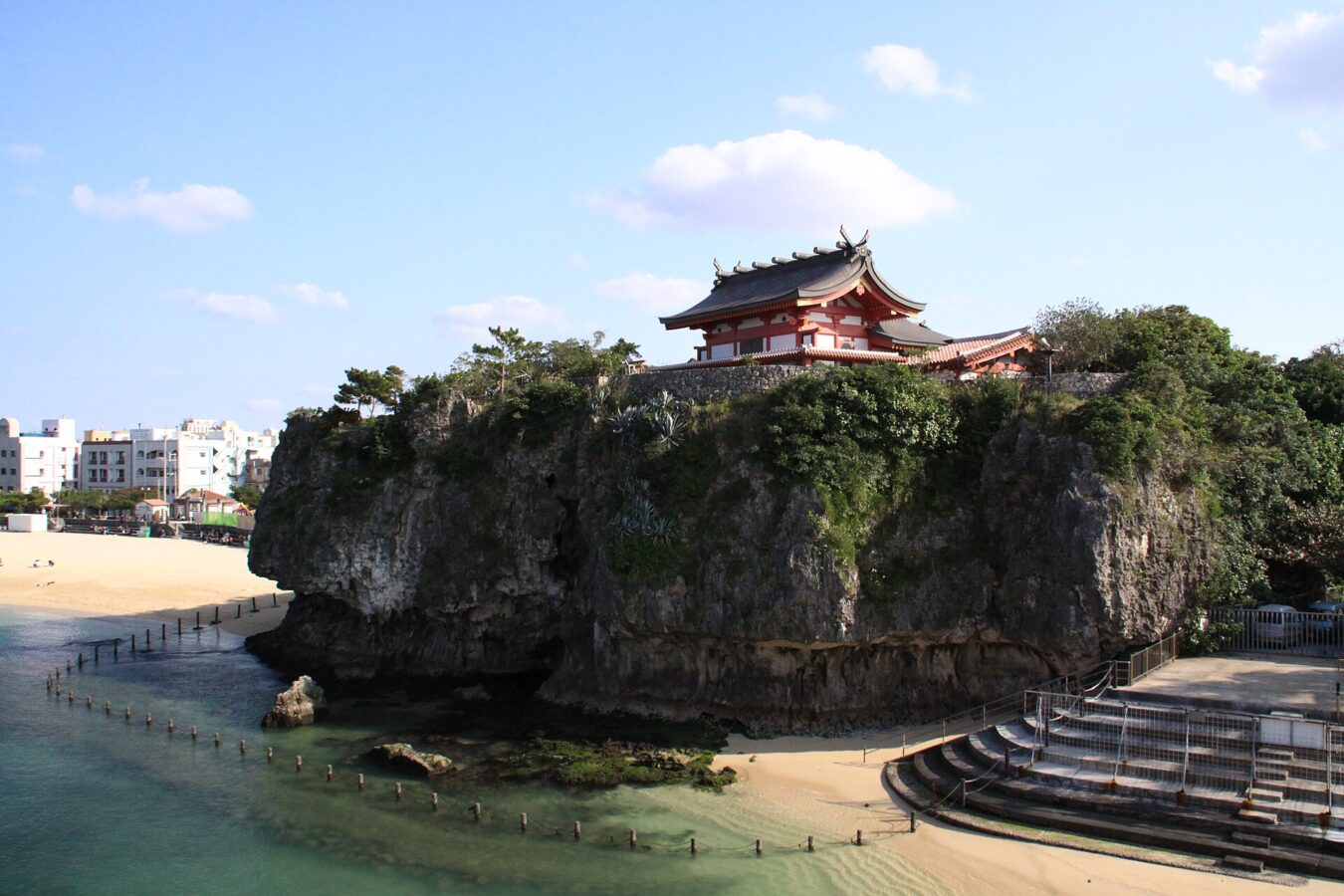
Naminoue Shrine in Naha is the ichinomiya, the leading shrine, of Okinawa Prefecture. It sits on a high bluff above Naminoue Beach and the sea. It was first a sacred place of the native Ryukyuan religion, dedicated for its setting to nirai kanai, the mythical source of all life, and to the sea. The name means “above the waves”; in Okinawan it is read Nanmin. It entered the State Shinto system in 1890 as a ranked, nationally significant shrine.
Asahibashi Station is about 1.1 km away in a straight line, and Kokusai-dori about 1.7 km.
Written by japan-spots.com (2026-09-22) from the sources credited on this page. Distances are straight lines between map positions.
Photos
Photos from Wikimedia Commons, each under its own licence — see credits
- The distant view of Naminouegū Honden — ChiefHira · CC BY-SA 3.0 · source · resized
- Yomochi Shrine and Ukishima Shrine in Naminoue Shrine — そらみみ (Soramimi) · CC BY-SA 4.0 · source · resized
- Naminouegū Honden — ChiefHira · CC BY-SA 3.0 · source · resized
- Naminouegu05s5s3200 — 663highland · CC BY 2.5 · source · resized
- Naminouegu04n3200 — 663highland · CC BY 2.5 · source · resized
- Naminouegu03s5s3200 — 663highland · CC BY 2.5 · source · resized
- Naminouegu02n3200 — 663highland · CC BY 2.5 · source · resized
- Naminouegu01n3200 — 663highland · CC BY 2.5 · source · resized
- Gokokuji, Naha — ChiefHira · CC BY-SA 3.0 · source · resized
- 2021-04-08 Naminouegu,Naha,Okinawa(波上宮) DJI Mini2-0003 — 松岡明芳 · CC BY-SA 4.0 · source · resized
What this place is
Naminoue Shrine (波上宮) is a Shinto shrine in Naha, Okinawa Prefecture, Japan, the ichinomiya (primary shrine) of the prefecture. It sits atop a high bluff, overlooking Naminoue Beach and the ocean. Originally a sacred space of the native Ryukyuan religion, due to its location and natural beauty, it was dedicated to nirai kanai, the mythical source of all life, and to the sea. At some point it came to be known as Hana gusuku and Nanminsan; Nanmin is the Okinawan reading of 波上, meaning "above the waves", which is pronounced as Naminoue in Japanese. In 1890, it was recognized in the system of State Shinto. It is among the ranked, nationally significant shrines or Kanpei-shōsha (官幣小社).
Visitor information checked: 2026-10-05 · 波上宮 · 波上宮
Background text adapted from Wikipedia (CC BY-SA 4.0)
What to expect at this type of place: Shrine
Nearby station
Nearby station: Asahibashi, about 1.1 km from the spot in a straight line.
Worked out on 2026-09-14 from this place’s map position, using HeartRails Express station data and station names from Wikidata. The distance is a straight line, not a walking route, and says nothing about buses, transfers or timetables — plan the trip on Google Maps.
Traveler reviews
No reviews yet — be the first to share how it went.