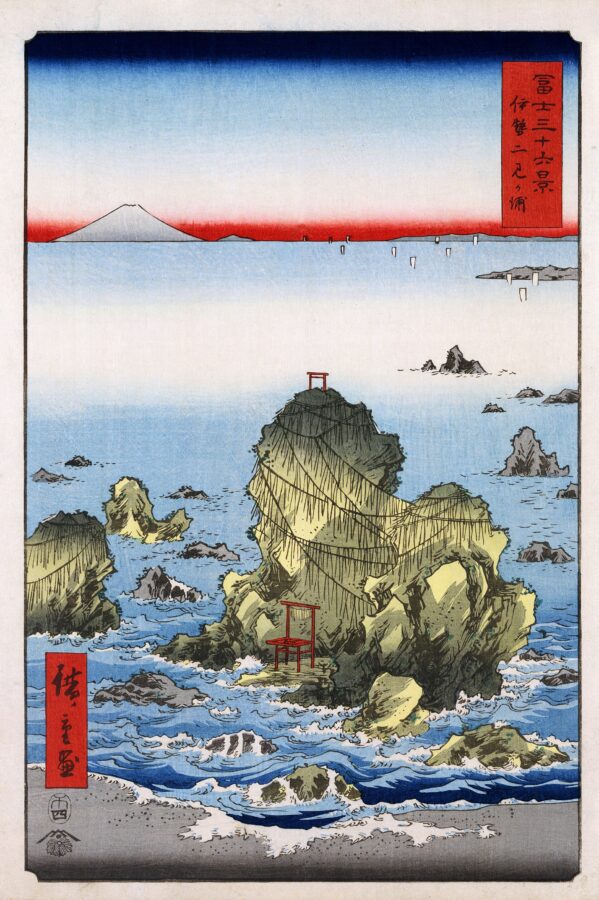
Meoto Iwa
夫婦岩
One of the places locals name first when asked what to see here.
Photos
Photos from Wikimedia Commons — click any image for the photographer and licence.
What this place is
Meoto Iwa (夫婦岩), or Married Couple Rocks, are a kind of rock formation seen as religiously significant in Shinto.They are a subtype of Iwakura rock.According to Shinto, the rocks represent the union of the creator kami, Izanagi and Izanami.The rocks, therefore, celebrate the union in marriage of man and woman.The most famous pair is the pair at Futami Okitama Shrine in Futami-ga-ura, two rocky stacks off the coast from Ise, Mie, Japan.They are joined by a shimenawa (a heavy rope of rice straw) and are considered sacred by worshippers of the shrine.The shimenawa, composed of five separate strands which each have a mass of 40 kilograms, must be replaced several times a year in a special ceremony.The larger rock, said to be male, has a small torii at its peak.At dawn during the summer, the sun appears to rise between the two rocks.Mount Fuji is visible in the distance.
Meoto Iwa (夫婦岩) is one of the standout places to visit in Mie. Give yourself unhurried time for photos, seasonal views, and nearby food stops. IC cards such as Suica, Pasmo, or ICOCA cover most trains and city buses.
Background text from Wikipedia (CC BY-SA)
Why it is worth the trip
- A setting that gives you the character of the area in a single visit.
- Scenery and detail that shift with the season, the weather and the time of day.
- Easy to combine with other stops nearby, so it works as the anchor of a half-day plan.
What you can do here
- Take the main viewpoint first, then explore the quieter edges most visitors skip.
- Read the on-site information boards — they usually explain far more than online listings.
- Photograph in the early morning or late afternoon for the best light and fewest people.
- Pair the visit with a nearby café, market or hot spring to round out the trip.
Getting there by public transport
- JR Sangū Line to Futaminoura, walk to shore.
- Nearest station/stop: Futaminoura.
Good to know before you go
- Check the last admission and last bus/train before you go; rural services stop early.
- Carry cash — smaller sites and rural transport may not accept cards or IC.
- Weekday mornings are consistently the calmest time to visit.
Traveler reviews
No reviews yet — be the first to share how it went.