Usual hours and prices, checked 2026-10-06 against the sources under “What this place is”. They can change for holidays and events — confirm before you go. Official site
Our guide
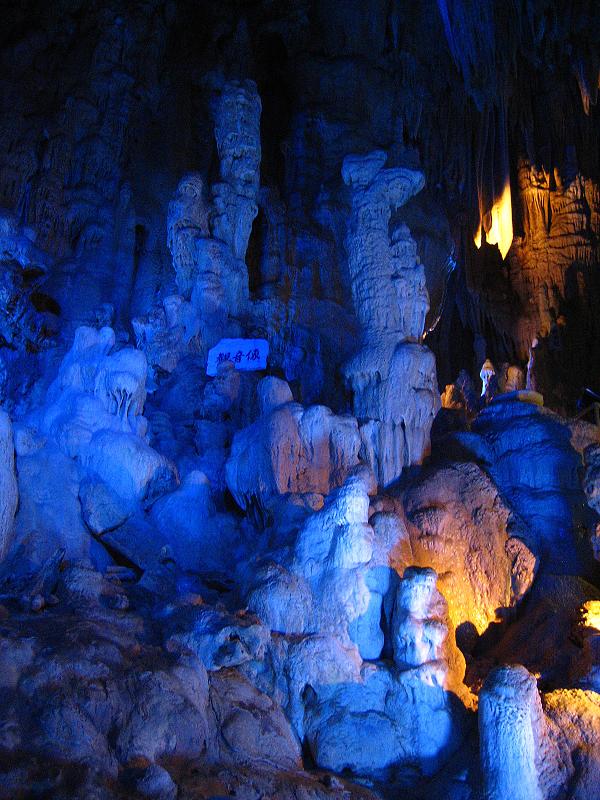
Abukuma-dō is a limestone cave northeast of the city of Tamura, Fukushima. It was discovered on 15 August 1969, first named Kamayama Shōnyūdō, designated a natural heritage of the town in 1971 and renamed Abukuma-dō in 1973. Visitors follow a 600 m path through the cave, plus a 120 m exploration course, among the stalactites and stalagmites; about 2,500 m more lies beyond, closed to the public.
Nearby is the smaller Irimizu Limestone Cave, discovered in 1927 and designated a Natural Monument in 1934.
We have not checked opening hours, fees or a public-transport route, so plan the journey on the map and look for local information before you go.
Written by japan-spots.com (2026-09-22) from the sources credited on this page. Distances are straight lines between map positions.
Photos
Photos from Wikimedia Commons, each under its own licence — see credits
- Flowstones and Mushroom Rocks inside Abukuma-do Cave — Brian Adler 09:29, 17 June 2007 (UTC) · Public domain · source · resized
- Boxwork Formation at Abukuma-do Cave — Brian Adler, BrianAdler · Public domain · source · resized
- Abukuma limestone bluff — ja:User:NEON / User:NEON_ja · CC BY-SA 2.5 · source · resized
- あぶくま洞 - panoramio — CyberOyaji · CC BY-SA 3.0 · source · resized
- あぶくま洞 - panoramio - CyberOyaji (1) — CyberOyaji · CC BY-SA 3.0 · source · resized
- あぶくま洞 - panoramio - CyberOyaji (2) — CyberOyaji · CC BY 3.0 · source · resized
- あぶくま洞 - panoramio (1) — CyberOyaji · CC BY-SA 3.0 · source · resized
- Abukuma 20220102155740 (52267398699) — inunami · CC BY 2.0 · source · resized
- Abukuma 20220102153515 (52267625190) — inunami · CC BY 2.0 · source · resized
What this place is
Abukuma-dō (あぶくま洞 - Abukuma Cave) is a limestone cave located in Fukushima Prefecture, Japan. The cave was discovered on August 15, 1969, northeast of the city of Tamura and was originally named Kamayama Shonyu-do (釜山鍾乳洞). It was designated a natural heritage of the town on February 7, 1971, and renamed Abukuma-dō on June 1,1973.Visitors can traverse a 600-metre-long path inside the cave as well as a 120-metre-long exploration course to view the stalactites and stalagmites. Each stalactite has taken more than eighty million years to form. Beyond the public areas lie about 2,500 metres of cave that are not open to the public. Nearby Abukuma Cave is the smaller Irimizu Shonyu-do (入水鍾乳洞 - Irimizu Limestone Cave), discovered in 1927.Irimizu Limestone Cave was designated a National Natural Treasure on December 28, 1934.
Visitor information checked: 2026-10-06 · Abukuma Cave: hours and admission
Background text from Wikipedia (CC BY-SA 4.0)
What to expect at this type of place: National park
Getting there
We do not have step-by-step transit directions for this spot yet. Open the location on Google Maps for routes from where you are staying.
Traveler reviews
No reviews yet — be the first to share how it went.